Ethereum ranks as the second-largest cryptocurrency project by market capitalization, following only Bitcoin. Let’s explore how this project formed and evolved!

What is Ethereum?
Ethereum is a decentralized layer-1 blockchain platform that enables smart contract execution and application building without intermediaries. Unlike centralized systems like Google’s servers, Ethereum utilizes a global computer network to maintain and validate transactions. This approach ensures transparency, security, and freedom from centralized control.
With Ethereum, developers can create various decentralized applications (DApps) including games, decentralized finance (DeFi) platforms, and databases without relying on banks or financial institutions. Thanks to its flexibility and security features, Ethereum has become one of the most popular blockchains, driving the development of the Web3 ecosystem.
Ethereum’s Origin Story
Ethereum originated from Vitalik Buterin’s vision, who published the first whitepaper in November 2013 explaining the platform’s functionality. The project quickly attracted prominent developers including Gavin Wood, Charles Hoskinson, Joseph Lubin, and others.
In 2014, Ethereum gained widespread attention when Buterin introduced the project at a Bitcoin conference in Miami. To fund development, the team organized an ICO (Initial Coin Offering) in September of that year, raising millions of dollars.
By July 2015, Ethereum launched its beta version, paving the way for developers to build decentralized applications (DApps) based on smart contracts. After years of development, in September 2022, Ethereum officially transitioned to a Proof-of-Stake consensus mechanism through “The Merge” upgrade, significantly improving network performance and reducing energy consumption.
The DAO Hack and Its Impact on Ethereum
In May 2016, The DAO (Decentralized Autonomous Organization) launched on Ethereum, designed to function as a decentralized investment fund. Within just over a month of fundraising, The DAO collected $162 million from the community. The system allowed investors to divide funds into smaller groups (Child DAOs) to focus on specific objectives.
On June 12, 2016, Stephan Tual, one of The DAO’s developers, discovered a vulnerability in the smart contract but believed it posed no danger. However, before the flaw could be fixed, on June 18, 2016, a hacker exploited this vulnerability and withdrew over 3.6 million ETH (worth approximately $70 million at the time) into a sub-account of The DAO. This incident caused ETH’s price to drop dramatically from $20 to under $13.
Recovery Solution
To prevent the hacker from withdrawing funds, the Ethereum community initially proposed a Soft Fork, but shortly after, a more robust Hard Fork solution was presented to return the stolen ETH to investors. The Hard Fork moved all ETH from the hacker’s account and the remaining funds in The DAO to a special account called “Refund DAO.”
On July 20, 2016, the Hard Fork was implemented at block 1,920,000, causing a split in the community. One group maintained the original blockchain version, calling it Ethereum Classic (ETC), while the majority continued with the new Ethereum version (ETH) that exists today. This remains one of the most significant events in Ethereum’s history, establishing foundations for debates about immutability and governance on blockchains.
DeFi Layer Structure on Ethereum
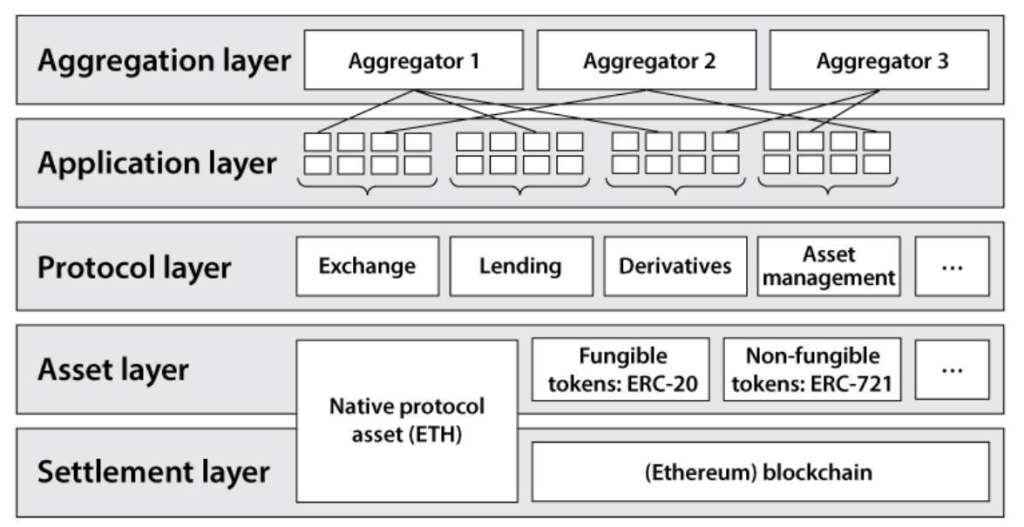
- Settlement Layer: This core foundation of the DeFi ecosystem includes the blockchain and its native asset (ETH on Ethereum, BTC on Bitcoin). This layer securely stores ownership information and ensures all transactions follow network rules, serving as the final settlement layer that verifies and protects system integrity.
- Asset Layer: This encompasses all assets issued on the blockchain, including native assets (ETH) and other tokens such as stablecoins (USDT, DAI), governance tokens (UNI, AAVE), and derivative tokens. This component is crucial for expanding the ecosystem and creating various use cases within DeFi.
- Protocol Layer: This layer provides standards and foundations for DeFi applications, playing a vital role in the ecosystem. It includes DEXs (Uniswap, SushiSwap) for decentralized asset trading, lending markets (Aave, Compound) supporting automated lending, derivatives trading (dYdX, Synthetix) offering futures contracts and synthetic assets, and asset management protocols (Yearn Finance, Balancer) for yield optimization. These protocols are deployed as highly interactive smart contracts that help expand the DeFi ecosystem.
- Application Layer: This interface layer helps users connect directly with DeFi protocols through applications like blockchain wallets (MetaMask, Trust Wallet), transaction aggregation platforms (1inch, Matcha), and asset management tools (Zapper, DeBank). This layer simplifies DeFi usage, allowing users to interact with smart contracts without needing deep understanding of the underlying technology.
- Aggregation Layer: This extends the application layer’s functionality by optimizing user experience. It aggregates data from multiple protocols and provides support tools like interest rate comparison, transaction fee analysis, automatic optimal investment strategy search, and integration of multiple services into a single platform, saving time and costs. Notable platforms in this layer include Yearn Finance, 1inch, and Paraswap.
Ethereum Ecosystem
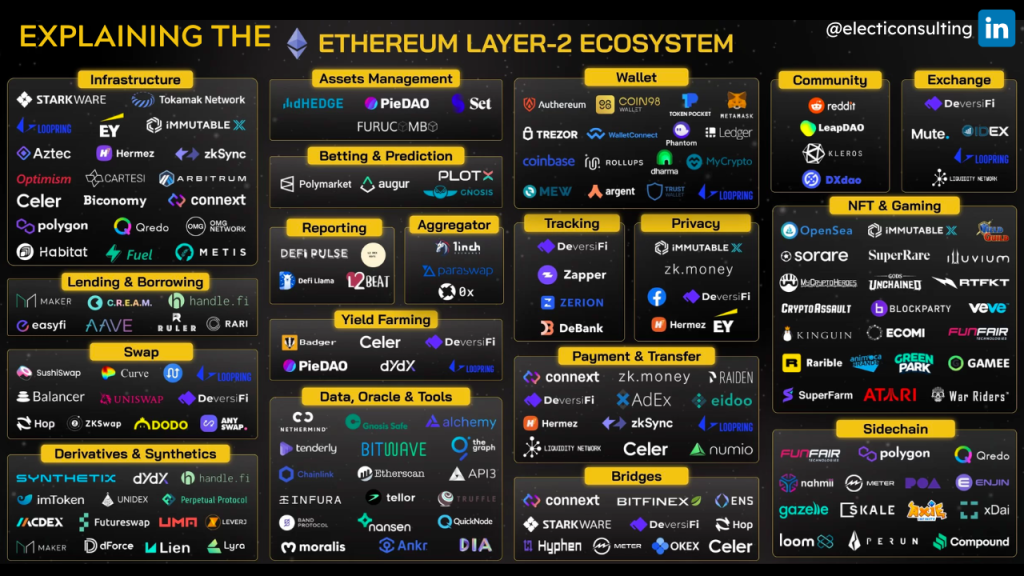
Ethereum boasts the most robust blockchain ecosystem with numerous projects spanning various fields.
Ethereum 2.0
Ethereum 2.0 was formerly the name for major Ethereum upgrades aimed at improving scalability, security, and sustainability. The most significant change was the transition from Proof-of-Work (PoW) to Proof-of-Stake (PoS), completed through The Merge event (2022).
Through the PoS mechanism, users can stake ETH to secure the network and receive rewards from new ETH issuance and transaction fees. Stakers can participate directly via the ETH 2.0 Launchpad (requiring minimum 32 ETH) or through exchange services and Liquid Staking platforms like Lido and Rocket Pool.
Another important goal is sharding, enabling Ethereum to process up to 100,000 transactions per second and reduce gas fees. The Pectra upgrade, following The Merge, is expected to double the number of “blob” transactions, optimizing costs for Layer-2.
The term “Ethereum 2.0” is no longer officially used; the network is now simply called Ethereum.
Ethereum’s Upcoming Pectra Upgrade
The Pectra upgrade represents an important milestone in Ethereum’s development following The Merge (2022) and Dencun (2024).
Implementation Roadmap
- Phase 1 (2025): Focus on Account Abstraction and validator upgrades.
- Phase 2 (2026): Addition of technical improvements like EVM Object Format (EOF) and PeerDAS.
- Testnet Deployment:
- Holesky: February 24, 2025
- Sepolia: March 5, 2025
- Bug Bounty Program: The Ethereum Foundation is offering $2 million in rewards until March 24, 2025, to find security vulnerabilities.
Key Upgrades (EIPs)
- EIP-7702: Account Abstraction (supporting gas fee sponsorship, asset recovery, cross-chain transactions, etc.).
- EIP-7251: Increasing stake limit from 32 ETH to 2048 ETH, helping reduce the number of validators.
- EIP-7002: Allowing validators to withdraw ETH directly from the execution layer, improving staking liquidity.
- EIP-7594: PeerDAS, optimizing Layer-2 for faster, cheaper transactions.
- EIP-7692: EVM improvements (EOF), enhancing smart contract performance.
- EIP-2935: Optimizing history data verification, reducing blockchain storage burden.
- Increased blob count: Ethereum will double the number of blobs from 3 to 6 per block, helping reduce transaction fees for Layer 2.
Pectra’s Impact
- Users: Lower gas fees, improved security, asset recovery support.
- Developers: Easier and more efficient smart contract deployment.
- Validators and Stakers: More flexible staking with lower risks.
Ethereum ETF
An Ethereum ETF (Ethereum Exchange Traded Fund) is a group of assets linked to ETH’s price that companies buy, sell, securitize, or trade on traditional exchanges rather than cryptocurrency exchanges.
Ethereum in the US National Cryptocurrency Reserve
US President Donald Trump officially confirmed Ethereum (ETH) will be included in the national cryptocurrency reserve, alongside Bitcoin (BTC), XRP, Solana (SOL), and Cardano (ADA). This move, announced on March 3, 2025, affirms the administration’s support for the crypto industry and enhances the United States’ position in this field.
ETH’s inclusion in the national reserve not only strengthens its role in the financial system but also demonstrates government confidence in Ethereum as an important technology platform. Following the announcement, ETH and other cryptocurrencies experienced growth, reflecting positive market response.
Token Standards on Ethereum
- ERC-20: The most common standard for tokens on Ethereum, used for most cryptocurrencies on this blockchain. ERC-20 ensures all tokens follow a common set of rules, making them easily tradable on exchanges and usable in DeFi applications. This standard includes regulations on total supply, balances, token transfers, and smart contract access. Notable ERC-20 tokens include USDT, DAI, and LINK.
- ERC-721: The standard for Non-Fungible Tokens (NFTs), which are unique, non-interchangeable tokens. Each ERC-721 token has distinct characteristics unlike any other token, making them suitable for applications like digital collectibles, digital art, and blockchain games. This standard has created the foundation for the robust growth of the NFT market with prominent projects like CryptoPunks and Bored Ape Yacht Club.
- ERC-1155: This standard combines ERC-20 and ERC-721, allowing a single smart contract to contain both fungible tokens and NFTs. This helps save gas fees when transacting large numbers of tokens simultaneously and optimizes asset management on the blockchain. It’s particularly useful in blockchain gaming, where users can own multiple types of items with different attributes.
- ERC-777: An upgraded version of ERC-20, providing new features such as safer transaction support, allowing smart contracts to verify transactions before processing, helping prevent errors in sending tokens to incorrect addresses. Additionally, ERC-777 helps improve performance and flexibility in token transactions on Ethereum.
- ERC-4626: This standard is specifically designed for DeFi Vaults, optimizing asset management in yield pools such as staking or lending. It helps standardize how asset management protocols track user ownership shares in pools, making the DeFi ecosystem operate more efficiently.
- ERC-827: This standard extends ERC-20 by allowing token transactions to carry additional data. This enhances token integration into DeFi applications and more complex smart contracts. For example, it can be used to attach notes or reference numbers to transactions.
- ERC-884: This standard is designed for tokenizing real assets, such as company shares or real estate. It helps fractionate ownership of real-world assets, increasing liquidity and creating new investment opportunities on the Ethereum blockchain.
- ERC-865: This standard helps users conduct token transactions without needing to own ETH for gas fees. Instead, transaction fees can be paid by another party, enhancing user experience, especially for newcomers to the cryptocurrency market.
Detailed Information About ETH Token
Technical Parameters of ETH Token
- Token Name: Ethereum
- Ticker: ETH
- Blockchain: Ethereum
- Token Standard: ERC-20
- Current Total Supply: 120,592,467 ETH
- Circulating Supply: 120,592,467 ETH
- Maximum Supply: Unlimited
ETH Token Distribution
- Initial Supply: Ethereum had an initial total supply of 75 million ETH, of which 72 million ETH were sold in the 2015 ICO at a price of 1 ETH = $0.311.
- Genesis Block: The genesis block contained 72,009,990.50 ETH, with $60 million raised from the Crowdsale and $12 million from other fundraising rounds.
- Block Rewards: Total rewards from block mining amount to 47,223,894.59 ETH.
- Uncle Rewards: Rewards for invalid blocks that still contributed to the network total 3,139,986.13 ETH.
- Ethereum 2.0 Staking Rewards: Total ETH generated from staking on Ethereum 2.0 amounts to 2,793,779.59 ETH.
- ETH Burned According to EIP-1559: Due to the transaction fee burning mechanism according to proposal EIP-1559, 4,572,696.88 ETH have been removed from the supply.
- Current Ethereum Total Supply: 120,592,467 ETH.
Uses of ETH Token
- Gas Fee Payment: ETH is used to pay gas fees for transactions and smart contracts on the Ethereum network.
- Staking: Users can stake ETH to become validators (transaction validators) and receive rewards from the Ethereum 2.0 network.
- Priority Fee Payment: ETH can be used to pay priority fees, helping transactions be confirmed faster than others.
Where to Buy and Sell ETH Token
You can trade ETH on the following exchanges: Coinbase, Binance, Bybit, OKX, Kucoin, Gate.io, MEXC, and others.
ETH Token Storage Wallets
You can choose from the following wallet types:
- Exchange wallets
- Common ETH wallets: MetaMask, Rabby Wallet, Trust Wallet, etc.
- Hardware wallets: Ledger, Trezor, etc.
Ethereum Foundation Development Team
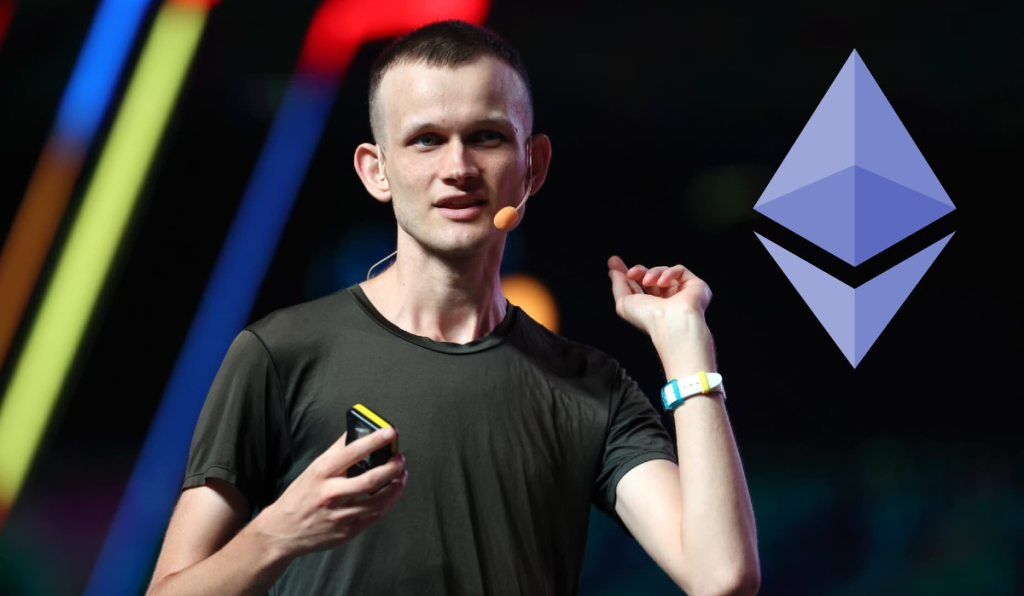
Vitalik Buterin – Founder and Visionary
While not holding an official management role at EF, Vitalik Buterin remains highly influential in the Ethereum community. He regularly offers ideas and analyses on important issues, helping shape Ethereum’s long-term development direction.
Ethereum Foundation (EF)
Among the organizations mentioned, EF is considered the most important non-profit organization, tasked with supporting protocol research and development while building community. Key members include:
- Aya Miyaguchi (Chairperson): Formerly the Executive Director of EF, she now serves as Chairperson, focusing on external relations and connecting with major organizations.
- Hsiao-Wei Wang (Co-Executive Director): A longtime Ethereum researcher who plays an important role in Taiwan’s Ethereum community.
- Tomasz Stanczak (Co-Executive Director): Founder of Nethermind, who joined EF to support Ethereum network management and development.
Website: https://ethereum.foundation/
Ethereum Research and Development Team
This team includes top researchers and engineers responsible for Ethereum’s critical upgrades:
- Danny Ryan: Played a crucial role in The Merge event, now co-founder of Etherealize, focusing on connecting TradFi with Ethereum.
- Justin Drake and Dankrad Feist: Core Ethereum researchers involved in important upgrades like Pectra. They previously advised EigenLayer but withdrew to avoid conflicts of interest.
- Barnabé Monnot: Ethereum economics researcher, focusing on issues like transaction fees and network economic models.
- Ansgar Dietrichs: Ethereum Foundation researcher with important contributions to Ethereum’s rollup-centric strategy.
Organizations and Communities Supporting Ethereum
Beyond the Ethereum Foundation, many organizations contribute to Ethereum’s development, including:
- Nethermind: An Ethereum software development and research unit providing tools for developers and businesses.
- Consensys: A company founded by Joseph Lubin, specializing in building applications and infrastructure on Ethereum, developing MetaMask and Infura.
- Ethereum Cat Herders: A group supporting coordination and management of Ethereum Improvement Proposals (EIPs).
- Enterprise Ethereum Alliance (EEA): A business alliance focused on implementing Ethereum in real-world business applications. EEA establishes technical standards, develops blockchain applications for businesses, and promotes cross-industry collaboration.
Recent Changes
The Ethereum Foundation recently underwent major leadership changes. Aya Miyaguchi left the CEO position to become Chairperson, focusing on external relations. Two new co-CEOs were appointed: Hsiao-Wei Wang, an Ethereum researcher, and Tomasz Stanczak, Nethermind’s founder.
Danny Ryan, who made major contributions to The Merge, returned to the Ethereum ecosystem as co-founder of Etherealize, a platform helping TradFi participate in Ethereum.
Researchers like Justin Drake, Dankrad Feist, Barnabé Monnot, and Ansgar Dietrichs continue contributing to Ethereum upgrades.
These changes occurred amid community pressure regarding EF’s development pace and strategy, prompting adjustments to adapt to market conditions.
Summary
Ethereum is a decentralized blockchain network founded in 2014 by Vitalik Buterin. Currently, Ethereum is the second-largest cryptocurrency project by market capitalization, following only Bitcoin in the crypto market.
Through this article, you should now have a better understanding of basic information about the project to make your own investment decisions.