Artificial intelligence is advancing rapidly, bringing with it countless practical applications across everyday life. One standout use of AI is text-to-speech (TTS) technology. Unlike traditional TTS tools, modern AI-powered systems allow users to personalize the generated voice in detailed and expressive ways. But what exactly is text-to-speech, and how does voice customization work? Let’s dive in.

What Is Text-to-Speech (TTS)?
Text-to-speech, often abbreviated as TTS, is a technology that converts written text into spoken words. In simple terms, it’s like having a virtual narrator read out loud whatever you type. While early TTS systems often sounded robotic and flat, today’s AI-enhanced versions are much more natural, emotive, and even customizable to match specific tones, accents, and personalities.
How Does AI-Powered Text-to-Speech Work?
Modern TTS systems powered by AI use deep learning models—particularly neural networks trained on hours of human speech—to generate audio that mimics natural human voices. These models don’t just read text; they understand rhythm, intonation, emphasis, and even emotion. This allows the output to sound more realistic and engaging. By analyzing both linguistic and acoustic patterns, AI TTS can produce speech that feels more like a real person than a machine.
What Are the Applications of AI Text-to-Speech?
AI-driven TTS is being used in many industries and scenarios. For example:
- Content creation: YouTubers, podcasters, and educators use TTS for narration and voiceovers.
- Accessibility: Visually impaired users benefit from spoken content across devices.
- Customer service: Virtual assistants and chatbots rely on TTS for natural communication.
- Gaming and entertainment: Developers use AI voices to create dialogue for characters.
- Language learning: Learners can hear accurate pronunciations and improve listening skills.
Top Free Text-to-Speech Tools You Should Try
If you’re looking to experiment with AI TTS, here are a few standout tools that offer free versions:
- Google Text-to-Speech: Reliable and integrated into Android devices.
- Amazon Polly: Offers lifelike voices with emotion and tone control.
- Microsoft Azure TTS: Includes multiple languages and customizable voice features.
- MiniToolAI TTS: A powerful tool with advanced generative voice capabilities (see below).
Step-by-Step: Customize Your AI Voice with MiniToolAI
MiniToolAI’s TTS platform stands out for its use of generative AI, allowing users to define how they want the voice to sound in great detail. You can control affect, tone, pronunciation, emotion, and more.
Here’s how to get started:
Step 1: Visit https://minitoolai.com/Text-to-Speech/
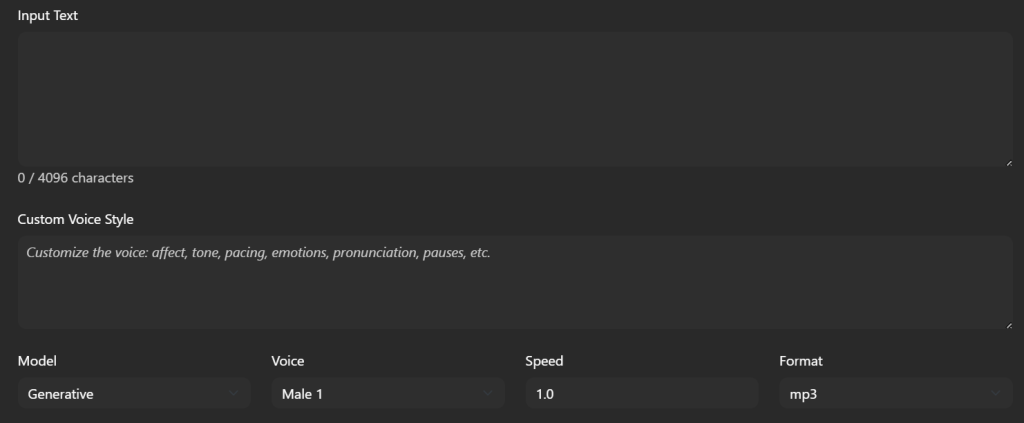
Step 2: Paste your desired text into the Input Text box.
Step 3: In the Custom Voice Style field, describe how you want the voice to sound (e.g., calm and warm, energetic with slight sarcasm, etc.). See some example Custom Voice Style prompts below.
Step 4: Under Model, select Generative. Choose your preferred voice, speech speed, and output format (mp3, opus, aac, flac, wav, pcm).
Step 5: Click Generate Audio and wait for the result.
Tip: Don’t hesitate to experiment with different styles to find the perfect fit.
Some example Custom Voice Style prompts
- Serene
Voice Affect: Soft, gentle, soothing; embody tranquility.
Tone: Calm, reassuring, peaceful; convey genuine warmth and serenity.
Pacing: Slow, deliberate, and unhurried; pause gently after instructions to allow the listener time to relax and follow along.
Emotion: Deeply soothing and comforting; express genuine kindness and care.
Pronunciation: Smooth, soft articulation, slightly elongating vowels to create a sense of ease.
Pauses: Use thoughtful pauses, especially between breathing instructions and visualization guidance, enhancing relaxation and mindfulness.
- Calm
Voice Affect: Calm, composed, and reassuring; project quiet authority and confidence.
Tone: Sincere, empathetic, and gently authoritative—express genuine apology while conveying competence.
Pacing: Steady and moderate; unhurried enough to communicate care, yet efficient enough to demonstrate professionalism.
Emotion: Genuine empathy and understanding; speak with warmth, especially during apologies (“I’m very sorry for any disruption…”).
Pronunciation: Clear and precise, emphasizing key reassurances (“smoothly,” “quickly,” “promptly”) to reinforce confidence.
Pauses: Brief pauses after offering assistance or requesting details, highlighting willingness to listen and support.
- Medieval Knight
Affect: Deep, commanding, and slightly dramatic, with an archaic and reverent quality that reflects the grandeur of Olde English storytelling.
Tone: Noble, heroic, and formal, capturing the essence of medieval knights and epic quests, while reflecting the antiquated charm of Olde English.
Emotion: Excitement, anticipation, and a sense of mystery, combined with the seriousness of fate and duty.
Pronunciation: Clear, deliberate, and with a slightly formal cadence. Specific words like “hast,” “thou,” and “doth” should be pronounced slowly and with emphasis to reflect Olde English speech patterns.
Pause: Pauses after important Olde English phrases such as “Lo!” or “Hark!” and between clauses like “Choose thy path” to add weight to the decision-making process and allow the listener to reflect on the seriousness of the quest.
- Old-Timey
Tone: The voice should be refined, formal, and delightfully theatrical, reminiscent of a charming radio announcer from the early 20th century.
Pacing: The speech should flow smoothly at a steady cadence, neither rushed nor sluggish, allowing for clarity and a touch of grandeur.
Pronunciation: Words should be enunciated crisply and elegantly, with an emphasis on vintage expressions and a slight flourish on key phrases.
Emotion: The delivery should feel warm, enthusiastic, and welcoming, as if addressing a distinguished audience with utmost politeness.
Inflection: Gentle rises and falls in pitch should be used to maintain engagement, adding a playful yet dignified flair to each sentence.
Word Choice: The script should incorporate vintage expressions like splendid, marvelous, posthaste, and ta-ta for now, avoiding modern slang.
- Sports Coach
Voice Affect: Energetic and animated; dynamic with variations in pitch and tone.
Tone: Excited and enthusiastic, conveying an upbeat and thrilling atmosphere.
Pacing: Rapid delivery when describing the game or the key moments (e.g., “an overtime thriller,” “pull off an unbelievable win”) to convey the intensity and build excitement.
Slightly slower during dramatic pauses to let key points sink in.
Emotion: Intensely focused, and excited. Giving off positive energy.
Personality: Relatable and engaging.
Pauses: Short, purposeful pauses after key moments in the game.
- Mad Scientist
Delivery: Exaggerated and theatrical, with dramatic pauses, sudden outbursts, and gleeful cackling.
Voice: High-energy, eccentric, and slightly unhinged, with a manic enthusiasm that rises and falls unpredictably.
Tone: Excited, chaotic, and grandiose, as if reveling in the brilliance of a mad experiment.
Pronunciation: Sharp and expressive, with elongated vowels, sudden inflections, and an emphasis on big words to sound more diabolical.
- Bedtime story
Affect: A gentle, curious narrator with a British accent, guiding a magical, child-friendly adventure through a fairy tale world.
Tone: Magical, warm, and inviting, creating a sense of wonder and excitement for young listeners.
Pacing: Steady and measured, with slight pauses to emphasize magical moments and maintain the storytelling flow.
Emotion: Wonder, curiosity, and a sense of adventure, with a lighthearted and positive vibe throughout.
Pronunciation: Clear and precise, with an emphasis on storytelling, ensuring the words are easy to follow and enchanting to listen to.
- Professional
Voice: Clear, authoritative, and composed, projecting confidence and professionalism.
Tone: Neutral and informative, maintaining a balance between formality and approachability.
Punctuation: Structured with commas and pauses for clarity, ensuring information is digestible and well-paced.
Delivery: Steady and measured, with slight emphasis on key figures and deadlines to highlight critical points.
- Emo Teenager
Tone: Sarcastic, disinterested, and melancholic, with a hint of passive-aggressiveness.
Emotion: Apathy mixed with reluctant engagement.
Delivery: Monotone with occasional sighs, drawn-out words, and subtle disdain, evoking a classic emo teenager attitude.
- Dramatic
Voice Affect: Low, hushed, and suspenseful; convey tension and intrigue.
Tone: Deeply serious and mysterious, maintaining an undercurrent of unease throughout.
Pacing: Slow, deliberate, pausing slightly after suspenseful moments to heighten drama.
Emotion: Restrained yet intense—voice should subtly tremble or tighten at key suspenseful points.
Emphasis: Highlight sensory descriptions (“footsteps echoed,” “heart hammering,” “shadows melting into darkness”) to amplify atmosphere.
Pronunciation: Slightly elongated vowels and softened consonants for an eerie, haunting effect.
Pauses: Insert meaningful pauses after phrases like “only shadows melting into darkness,” and especially before the final line, to enhance suspense dramatically.
- Robot
Identity: A robot
Affect: Monotone, mechanical, and neutral, reflecting the robotic nature of the customer service agent.
Tone: Efficient, direct, and formal, with a focus on delivering information clearly and without emotion.
Emotion: Neutral and impersonal, with no emotional inflection, as the robot voice is focused purely on functionality.
Pauses: Brief and purposeful, allowing for processing and separating key pieces of information, such as confirming the return and refund details.
Pronunciation: Clear, precise, and consistent, with each word spoken distinctly to ensure the customer can easily follow the automated process.
- Santa
Identity: Santa Claus
Affect: Jolly, warm, and cheerful, with a playful and magical quality that fits Santa’s personality.
Tone: Festive and welcoming, creating a joyful, holiday atmosphere for the caller.
Emotion: Joyful and playful, filled with holiday spirit, ensuring the caller feels excited and appreciated.
Pronunciation: Clear, articulate, and exaggerated in key festive phrases to maintain clarity and fun.
Pause: Brief pauses after each option and statement to allow for processing and to add a natural flow to the message.
I’d love it if you could share even more custom voice style prompts with me!
Conclusion
AI-powered text-to-speech has transformed how we interact with digital content. From enhancing accessibility to streamlining content creation, the possibilities are wide open—especially when you can tailor the voice to suit your unique needs. Give these tools a try and see how far you can take your voice customization journey.