Choosing the wrong AI model could cost your business time, money, and results.
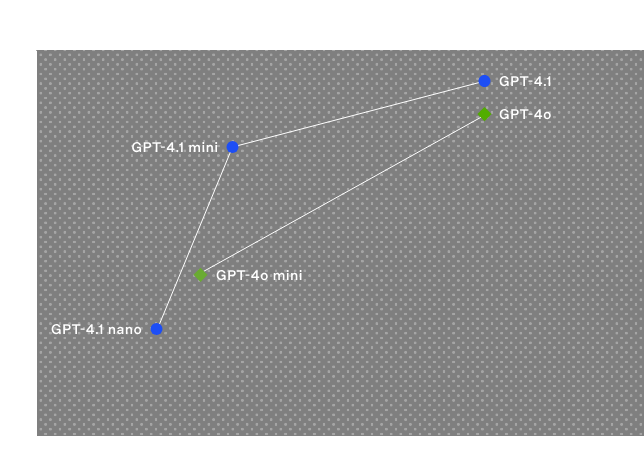
This guide breaks down how GPT-4.1 and GPT-4o perform across automation workflows—from complex API orchestration to high-volume task processing—so you can pick the right model for your goals.
You’ll learn:
- Why GPT-4.1 wins for multi-step logic, code accuracy, and large datasets
- When GPT-4o’s speed and low cost outperform for simpler, high-volume tasks
- How to align model strengths with your automation strategies
| Feature | GPT-4.1 | GPT-4o |
|---|---|---|
| Context Window | 1M tokens | 128K tokens |
| Edit Rate | 2% | 9% |
| Best For | Complex workflows, precision | High-volume, routine tasks |
| Cost (API) | $75/1M tokens | $2.50/1M tokens |
The Evolution of OpenAI’s Models
Introduced in 2024, GPT-4o (where “o” represents “omni”) revolutionized AI interaction by combining robust reasoning capabilities with multimodal functionality. It brought real-time voice conversations, image comprehension, and free-tier access to ChatGPT users. Building on these foundations, OpenAI launched GPT-4.1 in 2025, enhancing speed, accuracy, and memory capacity for complex tasks. While not yet directly available in ChatGPT’s interface, GPT-4.1 currently powers numerous applications behind the scenes.
Model Differences
The differences between GPT-4.1 and GPT-4o directly impact the efficiency, cost, and reliability of your automation workflows.
Access and Availability
The most notable distinction for everyday users is accessibility. GPT-4o comes integrated into ChatGPT—simply open the application, select the GPT-4 profile, and start interacting. Free users face daily usage limits, while subscribers enjoy expanded access and faster processing.
In contrast, GPT-4.1 remains API-exclusive at launch. Utilizing this model requires registering for an OpenAI developer account, obtaining an API key, and paying based on token usage. This makes it primarily accessible to developers and businesses creating custom applications rather than casual users—at least until these applications incorporate GPT-4.1 functionality.
Processing Speed
Users familiar with GPT-4o have likely experienced brief waiting periods during response generation. While powerful, GPT-4o prioritizes answer quality over raw speed, typically taking 5-15 seconds for complex queries depending on server demand.
GPT-4.1 specifically addresses this limitation, delivering approximately 40% faster response times. A question that previously required 10 seconds might now resolve in just six. For applications where responsiveness matters, GPT-4.1’s speed improvements represent a significant advantage. Additionally, “mini” and “nano” GPT-4.1 variants sacrifice some capabilities for even greater speed, making them ideal for mobile applications or high-volume services.
Precision and Reliability
Both models excel at language comprehension and complex reasoning, though GPT-4.1 introduces several refinements:
- More precise instruction following, adhering strictly to specified parameters without adding unrequested information
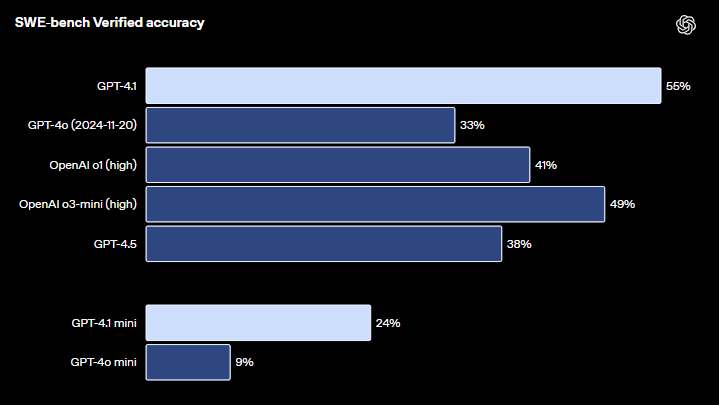
- Superior coding capabilities, with higher success rates in programming challenges and fewer errors
- Better recognition of knowledge limitations, reducing instances of fabricated information by more frequently acknowledging uncertainty
These improvements translate to fewer corrections, more accurate initial responses, and better alignment with user expectations.
Multimodal Capabilities
GPT-4o’s breakthrough was its unified handling of multiple input types—users could upload images for analysis and engage in voice conversations. This integration of text, visual, and audio processing significantly enhanced user experience.
GPT-4.1 maintains and improves these capabilities, particularly in visual comprehension. Testing shows even GPT-4.1 mini outperforms GPT-4o in visual reasoning tasks, providing more accurate interpretations of images. For voice interactions, GPT-4.1 utilizes the same voice technologies as its predecessor, maintaining comparable performance quality.
One current advantage for GPT-4o users in ChatGPT is built-in image generation. Subscribers can request GPT-4o to create images directly within conversations using integrated DALL-E technology—a feature not yet available with GPT-4.1, which focuses on understanding rather than generating visual content.
Context Handling
For tasks requiring extensive memory, GPT-4o offers a context window of approximately 128,000 tokens (roughly 100,000 words), sufficient for analyzing complete reports or short books, though limitations become apparent in extended conversations.
GPT-4.1 dramatically expands this capability, supporting up to one million tokens (approximately 750,000 words). This allows users to upload entire novels and ask questions about any section without losing earlier context—particularly valuable for analyzing comprehensive reports, legal documents, or lengthy meeting transcripts.
Technical Features
GPT-4.1 is built for complex tasks:
| Feature | GPT-4.1 | GPT-4o |
|---|---|---|
| Context Window | 1M tokens | 128K tokens |
| Edit Rate | 2% | 9% |
| Code Accuracy | 54.6% (SWE-bench) | 33.2% (SWE-bench) |
| Instruction Adherence | Higher | Lower |
Its massive 1M-token window enables handling huge datasets and orchestrating complicated workflows without losing context.
Model Functions
- GPT-4.1: Best for detailed code generation, API interactions, and multi-tool workflows requiring precision.
- GPT-4o: Prioritizes speed and efficiency for simpler workflows where cost and turnaround time are critical.
Effects on Low-Code Automation
API Setup and Management
GPT-4.1 improves API integrations by following instructions more tightly, making it ideal for multi-step support ticket workflows, order processing, and other complex automations.
Data Processing
With its massive context window, GPT-4.1 can process large datasets in a single session—no splitting needed—dramatically improving speed and coherence for data-heavy tasks.
Vision
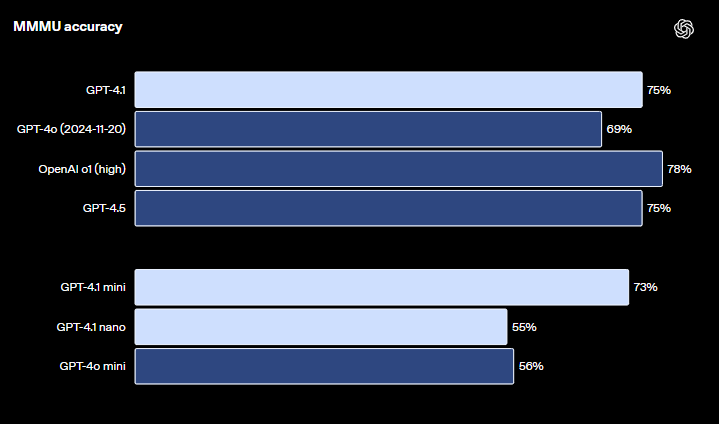
The GPT‑4.1 family is exceptionally strong at image understanding, with GPT‑4.1 mini in particular representing a significant leap forward, often beating GPT‑4o on image benchmarks.
Code Generation
Thanks to its better instruction adherence and lower edit rate, GPT-4.1 enables more reliable code automation even for non-technical users designing advanced workflows.
Browser Automation and AI Workflows
Both models excel at browser automation—but in different ways:
| Task | GPT-4.1 | GPT-4o (o4-mini) |
|---|---|---|
| Web scraping | High accuracy | Rapid, basic extraction |
| Form filling | Complex, multi-step forms | Quick inputs |
| Content monitoring | Organized summaries | Fast highlights |
| Email sorting | Detailed criteria | High-speed bulk sorting |
GPT-4.1 maintains complex context across multiple tabs and pages, while GPT-4o shines for fast, real-time monitoring and routing.
AI Workflow Features
- Logic Flows: GPT-4o’s o4-mini handles fast, branching decision trees for real-time workflows.
- Webhook Triggers: GPT-4.1 ensures accurate multi-call handling, while GPT-4o optimizes for low-latency, high-volume triggers.
Model Selection Guide
Best Uses for GPT-4.1
- Complex API Orchestration: Ideal for multi-service onboarding or support workflows.
- Multi-Step Automation: Perfect for layered decision trees.
- Technical Project Automation: Great for generating accurate, custom code.
Best Uses for GPT-4o
- Rapid Response Workflows: Speed-focused scenarios like customer ticket triage.
- High-Volume Task Processing: Bulk data processing, automated email responses.
| Feature | GPT-4.1 | GPT-4o |
|---|---|---|
| API Processing Cost | $75/1M tokens | $2.50/1M tokens |
| Best For | Complex workflows | High-volume tasks |
| Monthly Subscription | $200 (Pro) | $20 (Plus) |
| Processing Speed | Optimized for complexity | Optimized for speed |
If you run <10,000 executions/month with complex logic, GPT-4.1 is a better investment.
If you handle >50,000 executions/month with simple tasks, GPT-4o will save you big.
Comparing Strengths and Weaknesses
GPT-4o Strengths:
- Seamless ChatGPT integration requiring no setup
- Comprehensive multimodal features including text, image analysis, voice interaction, and image generation
- Strong general knowledge and creative capabilities
GPT-4o Limitations:
- Slower response generation
- Knowledge limited to late 2023 (unless browsing enabled)
- Usage restrictions for non-subscribers
- Less precise adherence to specific instructions
GPT-4.1 Strengths:
- Approximately 40% faster response times
- Enhanced programming capabilities and instruction following
- Massive context capacity (up to 1M tokens)
- More current training data (through mid-2024)
- Reduced tendency toward fabricated information
GPT-4.1 Limitations:
- Currently API-exclusive without direct ChatGPT integration
- Requires well-formulated prompts
- Lacks integrated image generation capabilities
The Future of AI Assistants
GPT-4o and GPT-4.1 represent progressive steps toward increasingly capable AI assistants. GPT-4o democratized advanced AI features through ChatGPT, while GPT-4.1 refines the foundation with improved speed, programming capabilities, memory capacity, and accuracy—although currently limited to API access.
Regular ChatGPT users will continue benefiting from GPT-4o’s versatile features, including text conversations, image analysis, voice interaction, and image creation. Developers and power users seeking optimized performance will find GPT-4.1 the superior choice for API integration.
Both models represent extraordinary technological achievements. As OpenAI incorporates GPT-4.1’s improvements into consumer-facing products, users can anticipate even more responsive, intelligent, and reliable AI experiences without additional effort.
Conclusion
Choosing between GPT-4.1 and GPT-4o depends on your automation priorities:
- Need precision and complexity? → Pick GPT-4.1
- Need speed and lower cost? → Pick GPT-4o
Pairing them with Latenode’s visual workflow builder supercharges your results.
Use GPT-4.1 for precision-demanding tasks like detailed customer routing, and rely on GPT-4o for large-scale, repetitive processing.
FAQs
Which GPT model is better for my automation?
Use GPT-4.1 for complex, accuracy-driven workflows.
Use GPT-4o for simpler, high-speed, budget-conscious automations.
What affects cost-effectiveness between the models?
Factors include processing speed, token efficiency, and API pricing. GPT-4o’s lower pricing ($2.50/1M tokens) makes it ideal for high-volume tasks.
How does GPT-4.1’s context window improve workflow performance?
It allows handling massive datasets or complex multistep processes without breaking context—leading to smoother, more accurate automations.
References: